
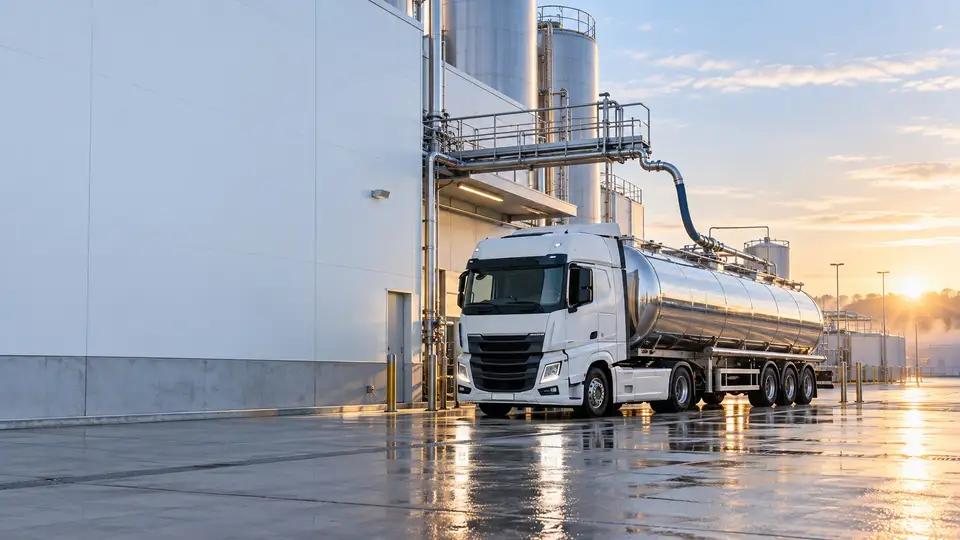
Tank truck transport
We carry liquid and dry bulk across Europe. For every load we choose the cistern by the properties of the cargo.
A specialist field that takes experience
Moving unpacked liquids and dry bulk in road tankers takes special knowledge, responsibility and precision. We know the technical and physical properties of cargo, the loading and unloading requirements, cistern design and cleaning.
A load often goes straight into a production line as raw material. So we keep to the agreed loading and unloading schedule, track the transit time and report unexpected events straight away.
We work under the 1956 CMR and 1975 TIR conventions, the INCOTERMS rules, the NSAB and LINEKA (Lithuanian forwarders) general forwarding conditions and the Lithuanian Civil Code. Dangerous and perishable loads travel under the 1957 ADR and 1970 ATP agreements, and drivers' hours follow the 1970 AETR.
What we check before every load
Tank purpose and marking
Food, non-food or ADR tank, and the special marking of cargo and tank.
Compartments, weight and volume
Number of separate compartments, weight and volume of cistern and load, cargo viscosity.
Cleaning and certificates
Cleaning to EFTCO requirements, ATP certificate, ADR compliance.
Temperature
Insulation, autonomous Webasto cargo heating, thermometers.
Loading equipment
Pumps, compressors, couplings and adapters, hose length, hatch protection.
Control
Metrological calibration, flow meters, pressure maintenance, sealing options.
Cistern types
Insulated tanks
The barrel is wrapped in about 100 mm of polyurethane foam, with 10 to 40 m³ capacity. With about 20 °C between cargo and air, the load cools by roughly 2–4 °C a day.
Tanks with Webasto heating
An insulated cistern with thermometers and independent heating. The load stays at the temperature it was loaded at for the whole trip, e.g. bitumen at 80 °C, chocolate at 40 °C.
Pumps and compressors
Built-in equipment loads and unloads without outside machinery, through hoses or pipes, even over long distances.
ADR tanks
Special barrel design, wiring, valves, marking and fire equipment. Only ADR-certified tractors pull them, with ADR-trained drivers.
Silo tanks
30–80 m³, compartments with cone hoppers in the floor. Dry bulk is loaded through the top hatches and blown off with a compressor.
Pressure tanks
Thicker walls, valves, filters and breathers. Pressure is held for the whole trip, and the cistern has a pressure test certificate.
Multi-compartment tanks
2 to 9 separate compartments of 2–25 m³, each with its own hatch and valve. One trip can carry several different products.
Calibrated tanks
Every compartment is volume-checked in a metrology lab. With the volume table, temperature and density, the quantity is known without a weighbridge.
Tanks with flow meters
Certified, sealed meters allow exact loading or unloading in parts at several sites. Common for petroleum products.
Food-grade and ATP tanks
Stainless steel, marked “Food only”, cleaned and disinfected to EFTCO. Perishable foodstuffs need an ATP certificate.
Hoses and couplings
Food and non-food hoses, Camlock, MK, VK, BSP and dry-break couplings from DN10 to DN324. We fit the tank truck to your equipment.
Dedicated tankers
Milk, bitumen, fuel, AdBlue and cement tankers each serve one type of load.
Additional requirements
- Cisterns meeting GMP and Kosher requirements
- CIP washing and sterile filters
- Black list check of previous loads
- EURO connections and 6–18 m hoses
Type in your product. We show which cistern it needs.
62
- Liquid food cargoVegetable oil (rapeseed, sunflower, soy, linseed, corn, olive, palm, coconut)Food-grade tankStainless steelWebasto heating
- Liquid food cargoWineFood-grade tankStainless steelEFTCO cleaning
- Liquid food cargoBeerFood-grade tankStainless steelEFTCO cleaning
- Liquid food cargoSpirits (ethyl alcohol, brandy, whisky)ADR class 3ADR tankFood-grade tankStainless steel
- Liquid food cargoDairy products (raw milk, cream, skim milk concentrate SMC, whey)ATP tankStainless steelInsulated
- Liquid food cargoAnimal fatsFood-grade tankWebasto heatingInsulated
- Liquid food cargoSyrups (sugar, fructose, glucose)Food-grade tankWebasto heatingPump
- Liquid food cargoLiquid chocolateFood-grade tankWebasto heatingInsulated
- Liquid food cargoLiquid food additivesFood-grade tankStainless steel
Have a load to move?
Tell us the route, the cargo and the tank requirements. We prepare a quote for your request.
Free tank truck?
We offer loads for your road tankers in many European countries. Partners value that we pay on time.
Frequently asked questions
How do you know which cistern a load needs?
For every load we analyse the technical requirements of cargo and tank: purpose, compartments, cleaning, temperature, loading equipment. If you are unsure, describe the load and we will advise.
Can you deliver straight to a production line?
Yes. We keep to the agreed loading and unloading schedule and track the transport until unloading.
Do you work on long-term contracts?
Yes. We carry one-off orders and long-term transport contracts and take part in transport tenders. We work on terms agreed and signed in advance.
Can one road tanker carry several different products?
Yes, a multi-compartment tank can. It carries as many different products at once as it has separate compartments, usually 2 to 9.
How are tank trucks loaded?
Through the top loading hatches or through the bottom outlets (pipes). Silo tanks are loaded through the top hatches.
How much cargo fits in one road tanker?
Within the European Union a road tanker usually carries about 25 t. For loads into or out of the EU, each country's law sets the permitted weight. The cargo density table shows how much space a load needs.
What temperature can a cistern hold?
An insulated tank loses only a few degrees a day. A tank with Webasto heating holds the cargo at the temperature it was loaded at for the whole trip: for example bitumen at 80 °C or chocolate at 40 °C. Give the exact range in your request.
Can you ship by sea ferry?
Yes. When a route crosses the sea, we ship tank trucks or sea containers by ferry.