
ADR
European agreement on the international carriage of dangerous goods by road (1957). It sets how dangerous goods are classified, marked and carried, and which tanks and drivers may carry them.
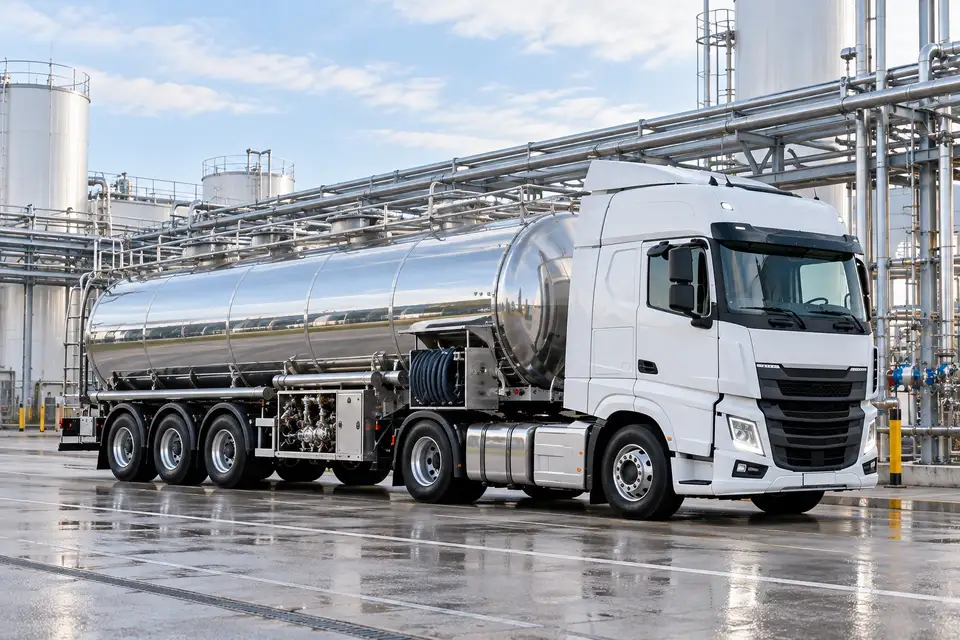
Short explanations of the most common terms in road tanker transport.
European agreement on the international carriage of dangerous goods by road (1957). It sets how dangerous goods are classified, marked and carried, and which tanks and drivers may carry them.
One of the nine groups of dangerous goods under ADR, such as class 3 (flammable liquids) or class 8 (corrosive substances).
Agreement on the work of crews in international road transport (1970): driving and rest times, tachographs.
Agreement on the international carriage of perishable foodstuffs (1970). It sets requirements for insulated and refrigerated equipment. Cisterns that carry perishable food need an ATP certificate.
A list of products a food-grade tank must not have carried before. It is checked before a food load.
The mass of one cubic metre of a dry bulk product, including the air between particles. It decides how many tonnes fit in a silo tank.
A cistern whose compartment volumes are verified in a metrology lab. The quantity is worked out from volume, temperature and density without a weighbridge.
Clean-in-place: the inside of the tank is cleaned with fixed spray systems. Often required for food loads.
Convention on the contract for the international carriage of goods by road (1956). The CMR consignment note goes with every international load and sets the carrier's liability.
European Federation of Tank Cleaning Organisations. Before loading, a tank is cleaned under EFTCO rules and receives an EFTCO cleaning document (ECD).
A stainless steel tank used only for foodstuffs. It is marked “Food only” and cleaned and disinfected before every load.
Trade terms such as EXW, FCA or DAP that set which party arranges and pays for transport and bears the risk.
A tank wrapped in about 100 mm of polyurethane foam, so the cargo temperature changes slowly.
A tank split into 2 to 9 separate compartments, each with its own hatch and valve. One trip can carry several products.
A cistern with reinforced walls that keeps the cargo under pressure. It holds a pressure test certificate.
A 30–80 m³ tank for dry bulk such as flour, sugar or granules. It is loaded from the top and unloaded with a compressor.
Air filters in the tank vents that keep dust and microorganisms out of food loads during loading and unloading.
Thermometers built into the tank show the cargo temperature for the whole trip. They are needed for heated and temperature-sensitive cargo.
Customs convention (1975) that lets goods under a TIR carnet cross borders without customs checks at each border.
A four-digit number that identifies a dangerous substance, such as UN 1170 for ethanol. It appears on the tank's orange plate and in the transport documents.
An independent heater that holds the cargo at the temperature it was loaded at for the whole trip, for example bitumen at 80 °C or chocolate at 40 °C.
Tell us the route, the cargo and the tank requirements. We prepare a quote for your request.
We offer loads for your road tankers in many European countries. Partners value that we pay on time.